CSRD double materiality template in Excel: what the assessment has to contain, and a workbook that does it
If your company reports under the Corporate Sustainability Reporting Directive, the double materiality assessment is the first thing the report rests on and the first thing the assurance provider tests. This page sets out what the assessment must contain under ESRS 1, with the section cited for each part, and shows the Excel workbook Bindler built to run it. It is a working method, not legal advice.
Who has to do one
CSRD (Directive (EU) 2022/2464) requires companies in scope to report under the European Sustainability Reporting Standards, adopted by Commission Delegated Regulation (EU) 2023/2772. Scope was narrowed by Directive (EU) 2026/470 (Omnibus I, in the Official Journal on 26 February 2026): from financial year 2027 a company reports when it exceeds 1 000 employees and EUR 450 million net turnover. Companies already reporting for FY2024 stay in for three financial years, with a Member State option to exempt those below the new thresholds for FY2025 and FY2026. If you are not sure which side of the line you are on, the $1 CSRD Size Test applies the thresholds to your figures and names the article.
The two perspectives
ESRS 1 requires every sustainability matter to be assessed from two directions, and a matter is material if it passes either test (ESRS 1, section 3.3, paragraph 28):
- Impact materiality: the company's actual or potential, positive or negative effects on people or the environment over the short, medium or long term, across its own operations and its value chain (ESRS 1, section 3.4).
- Financial materiality: the sustainability matter's effects on the company's cash flows, development, position, performance, cost of capital or access to finance (ESRS 1, section 3.5).
A template that scores only one axis, or that merges the two into a single number, does not meet the standard.
What the register needs, row by row
The unit of the assessment is the impact, risk or opportunity, the IRO. ESRS 1 gives the scoring factors:
| Perspective | What is scored | Factors (ESRS 1) |
|---|---|---|
| Negative impact | severity, then likelihood if the impact is potential | scale, scope, irremediable character (section 3.4, paragraph 45) |
| Positive impact | severity, then likelihood if potential | scale and scope (section 3.4, paragraph 46) |
| Risk or opportunity | magnitude of the financial effect and its likelihood | section 3.5, paragraph 51 |
So each row of a register needs: the ESRS topic and sub-topic, the type (negative impact, positive impact, risk, opportunity), where it sits in the value chain, the time horizon, whether it is actual or potential, the scores, and the two columns an assurance provider will ask for first: the stakeholders consulted and the evidence.
Thresholds are a governance decision
ESRS 1 does not set a numeric threshold. It requires the company to set thresholds for both perspectives, apply them consistently, and disclose them (ESRS 2, IRO-1). A common practice is a 1 to 5 scale on each factor with a cut-off around the middle, but the number is yours to set and to justify. Write down why. The assurance provider tests how you reached the conclusion, not just the conclusion.
From IRO to topic: which standards you report
A topical standard (E1 to E5, S1 to S4, G1) must be reported in full when at least one IRO under it is material. A topic assessed as not material may be omitted with a brief explanation, except climate change: if E1 is concluded not material, ESRS 1 paragraph 32 requires a detailed explanation of that conclusion. The assessment therefore has to roll up from the IRO rows to a per-topic conclusion, not stop at the register.
The workbook
The CSRD Double Materiality Assessment workbook does the above with live formulas, no macros, no locked cells. Five sheets:
- Guide: how to run the assessment, with the ESRS 1 sections cited.
- IRO Register: 60 rows, 23 columns. Yellow inputs (topic, sub-topic, type, description, value chain, time horizon, actual or potential, the four impact scores, the two financial scores, stakeholders, evidence, owner). Blue formulas compute severity, the impact materiality score, the financial materiality score and three flags: impact material, financially material, material on either.
- Topic summary: for each of the ten ESRS topics, IROs logged, highest impact score, highest financial score, material IROs and the topic conclusion, with the E1 detailed-explanation rule built in.
- Materiality matrix: every IRO plotted with financial score across and impact score up, labelled, fed from the register.
- Thresholds: the two thresholds as inputs (default 3.0 on 1 to 5), and the scoring scales for scale, scope, irremediability, likelihood and financial magnitude, so the meaning of a 4 is written down once.


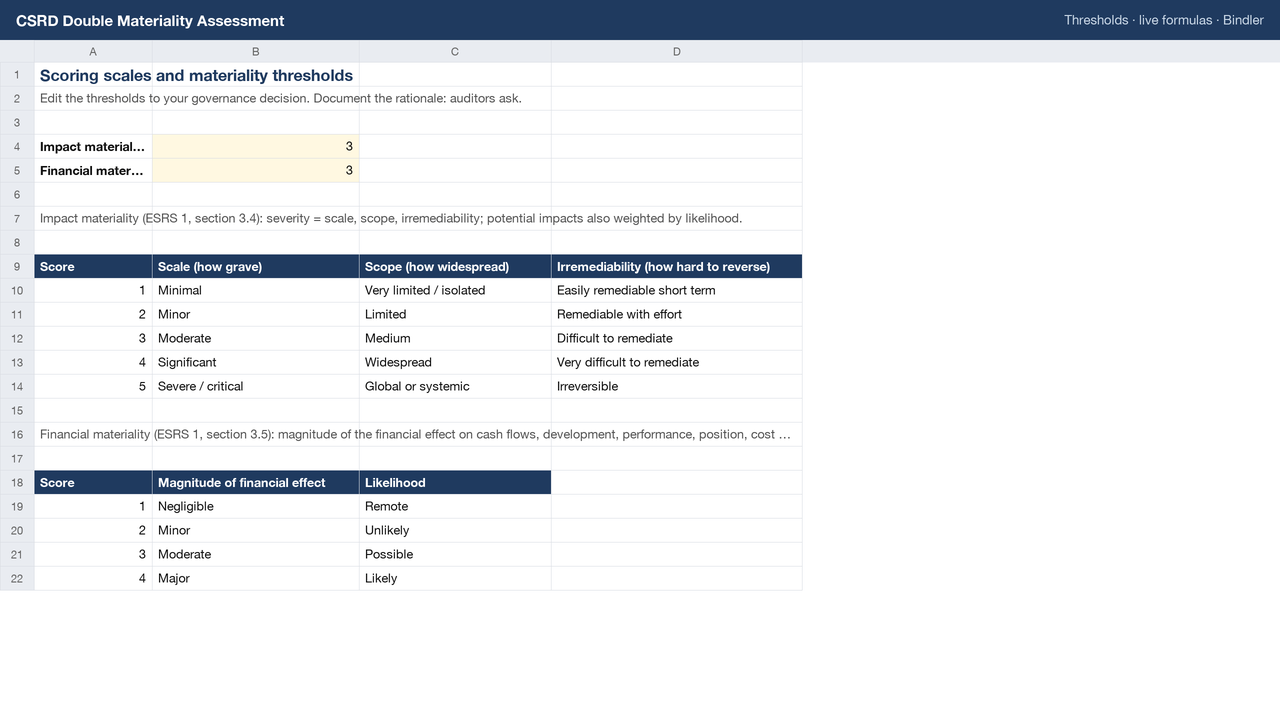
How it is scored: severity of a negative impact is the average of scale, scope and irremediability; of a positive impact, the average of scale and scope. A potential impact's score is severity multiplied by likelihood divided by 5; an actual impact keeps its severity. The financial score is magnitude multiplied by likelihood divided by 5. Each score is compared with its threshold on the Thresholds sheet. The workbook was recalculated with a formula engine and checked against a Python replica on eight worked IROs at two threshold settings before listing; the German (CSRD Wesentlichkeitsanalyse) and French (CSRD Analyse de double matérialité) editions carry the same formulas and were verified against the English file.
What it does not do
It does not identify your IROs for you: that is the stakeholder and value-chain work ESRS 1 section 3.4 asks for. It does not produce the ESRS 2 IRO-1 narrative, though the register and thresholds are the content of it. And it does not decide the thresholds; it makes them explicit.
Sources
- Directive (EU) 2022/2464 (CSRD), Official Journal L 322, 16 December 2022.
- Commission Delegated Regulation (EU) 2023/2772 (ESRS), Annex I: ESRS 1 sections 3.3, 3.4 and 3.5; ESRS 1 paragraph 32; ESRS 2 IRO-1.
- Directive (EU) 2026/470 (Omnibus I), Official Journal 26 February 2026, in force 18 March 2026.
Search terms this page answers: csrd double materiality template excel, esrs materiality assessment template, iro register excel, double materiality matrix template, esrs 1 impact materiality scoring.