PCAF financed emissions calculator in Excel: the attribution arithmetic, the data quality score, and a workbook that runs it
Banks, asset managers and insurers that report Scope 3 category 15 emissions do so under the Partnership for Carbon Accounting Financials' Financed Emissions Standard. The arithmetic is simple per position and tedious across a portfolio: an attribution factor per loan or investment, multiplied by the investee's emissions, aggregated, and disclosed with a data quality score. This page sets out that method as the Standard states it, and shows the Excel workbook Bindler built to apply it. It is a calculation aid, not a substitute for the Standard.
The Standard
The Financed Emissions Standard, third edition (PCAF, December 2025), is the Part A document. Its first edition was reviewed by the GHG Protocol and found in conformance with the Corporate Value Chain (Scope 3) Standard for category 15 for six asset classes: listed equity and corporate bonds, business loans and unlisted equity, project finance, commercial real estate, mortgages, and motor vehicle loans. Methods added in the second (December 2023) and third editions have not been through that review, as the Standard itself notes on its second page.
Attribution factor: what goes in the denominator
Financed emissions for a position are the investee's emissions multiplied by an attribution factor, which is the outstanding amount divided by a denominator the Standard prescribes for the asset class:
| Asset class | Denominator |
|---|---|
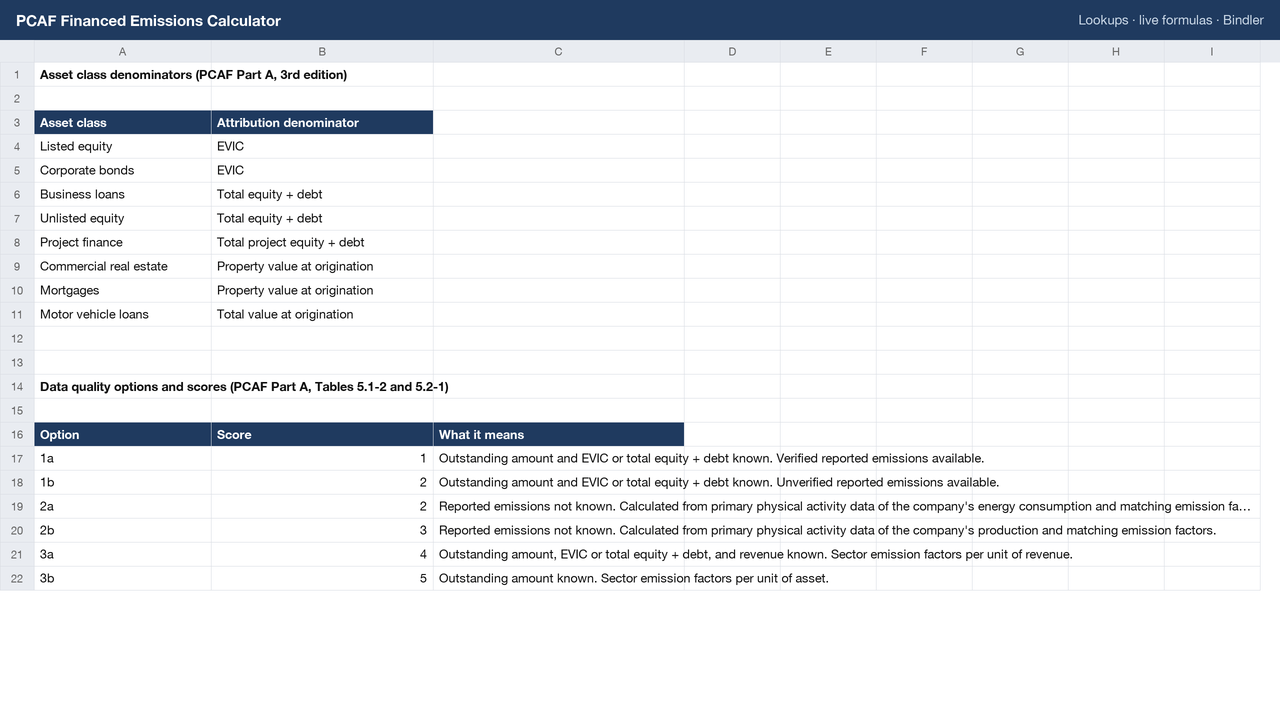
| Listed equity, corporate bonds | EVIC (enterprise value including cash) |
| Business loans, unlisted equity | Total equity plus debt |
| Project finance | Total project equity plus debt |
| Commercial real estate, mortgages | Property value at origination |
| Motor vehicle loans | Total value at origination |
EVIC is defined as the sum of the market capitalisation of ordinary shares at fiscal year-end, the market capitalisation of preferred shares at fiscal year-end, and the book values of total debt and minorities' interests, with no deduction of cash (so enterprise value cannot go negative). Where a private company's total equity is negative, the Standard says to set total equity to 0, so emissions attribute to the debt only. The attribution factor cannot exceed 1.
Data quality: the score you must disclose
Every position carries a data quality option that describes how the investee's emissions were obtained, and each option has a score from 1 (best) to 5 (weakest): 1a verified reported emissions, 1b unverified reported emissions, 2a and 2b emissions calculated from the company's physical activity data, 3a to 3c emissions estimated from sector factors applied to revenue or assets. The Standard asks institutions to disclose the exposure-weighted data quality score, with the Scope 3 score reported separately from Scope 1 and 2 (section 6), so a calculator has to carry the option on every row and weight it by outstanding amount.
The workbook
The PCAF Financed Emissions Calculator applies the above position by position, with live formulas, no macros, no locked cells. Four sheets:
- Guide: the method with the Standard's sections cited.
- Portfolio: 100 rows, 16 columns. Inputs: borrower, sector, asset class, outstanding amount, denominator value, investee Scope 1+2 and Scope 3 in tCO2e, data quality option, notes. Formulas: the denominator type the Standard prescribes (looked up from the asset class), the attribution factor capped at 1, financed Scope 1+2 and Scope 3, the data quality score and its weighted contribution.
- Summary: total outstanding, financed emissions by scope, economic intensity in tCO2e per million invested, the exposure-weighted data quality score, and a breakdown by asset class with a chart.
- Lookups: the asset class to denominator table and the data quality option table (Part A, Tables 5.1-2 and 5.2-1), so the mapping is visible and editable.


Worked line: a EUR 10 million loan to a private company with total equity plus debt of EUR 50 million gives an attribution factor of 0.2; if the company reports 4 000 tCO2e Scope 1+2, the financed Scope 1+2 emissions are 800 tCO2e. The workbook was recalculated with a formula engine and checked against hand-worked positions before listing (attribution factors 0.025, 0.25 and 0.60 across three asset classes, intensity 359.79 tCO2e per million, weighted data quality 3.0).
What it does not do
It does not source the investee emissions: reported figures, physical activity data or sector factors for options 3a to 3c come from your data provider, and the workbook has a Notes column to record the source per row. It does not cover the newer asset classes added in the second and third editions beyond the table above, and it does not write the disclosure narrative.
Sources
- PCAF, Financed Emissions Standard, third edition, December 2025 (Part A): sections 5.1 to 5.7 on asset class methods, Tables 5.1-2 and 5.2-1 on data quality, the weighted data quality guidance in section 6, and Annex 10.1.
- GHG Protocol, Corporate Value Chain (Scope 3) Accounting and Reporting Standard, category 15.
Search terms this page answers: pcaf financed emissions calculator excel, pcaf attribution factor evic, financed emissions template, pcaf data quality score, scope 3 category 15 calculator.