CBAM quarterly report template: why there is no quarterly report from 2026, what the annual CBAM declaration needs instead, and a workbook that prices it
If you are searching for a CBAM quarterly report template in 2026, the honest answer is that the quarterly report is over. It belonged to the transitional period, which ended on 31 December 2025. The definitive period that started on 1 January 2026 replaces it with one annual CBAM declaration per importer, and the first of those is not due until 30 September 2027. This page sets out what ended, what replaced it, what the declaration has to contain, and the Excel workbook Bindler built to estimate the certificate bill the declaration will carry. It is a cost estimate aid, not the declaration itself and not a registry filing guide.
What ended: the transitional-period quarterly report
Under Article 35 of Regulation (EU) 2023/956, every importer of CBAM goods had to submit a CBAM report for each quarter of the transitional period, no later than one month after the quarter's end, stating the quantity of goods, the direct and indirect embedded emissions, and any carbon price due in the country of origin. The transitional period ran from 1 October 2023 to 31 December 2025. The last quarterly report covered October to December 2025 and was due on 31 January 2026. No quarterly CBAM report exists for any period from 1 January 2026.
What replaced it: the annual CBAM declaration
The definitive period applies from 1 January 2026. Regulation (EU) 2025/2083 (the CBAM simplification, published in the Official Journal on 17 October 2025, in force 20 October 2025) reshaped the obligations before the first year began:
- Who declares. Only importers whose CBAM goods exceed a single mass threshold of 50 tonnes net in a calendar year, cumulative across iron and steel, aluminium, fertilisers and cement. Below 50 tonnes there is no declarant status, no certificates and no declaration. Electricity and hydrogen sit outside the mass threshold.
- Status. Importers above the threshold need authorised CBAM declarant status before they exceed it. Those who applied by 31 March 2026 may keep importing while the competent authority decides.
- The declaration. One per calendar year, submitted through the CBAM Registry by 30 September of the following year. The first declaration covers 2026 imports and is due by 30 September 2027.
- Certificates. Sales on the Commission's central platform start on 1 February 2027. Certificates for 2026 imports are priced on the quarterly average of 2026 EU ETS allowance prices, and the certificates matching the declaration are surrendered by the same 30 September 2027 date.
- Interim holding. At the end of each quarter the declarant must hold certificates covering at least 50% of the embedded emissions in goods imported since the start of the year (the original regulation said 80%).
What the annual declaration contains
Article 6(2) of Regulation (EU) 2023/956 lists the content, and the simplification kept the structure:
1. The total quantity of each type of goods imported during the preceding calendar year, in tonnes (or MWh for electricity), by CN code.
2. The total embedded emissions in those goods, in tonnes of CO2e per tonne of goods (or per MWh), calculated under Article 7 and verified where actual data are used.
3. The total number of CBAM certificates to be surrendered, after the reduction for a carbon price effectively paid in the country of origin (Article 9) and the adjustment for free allocation in the EU ETS (Article 31).
4. Copies of the verification reports issued by accredited verifiers, where the emissions are actual rather than default values.
So the work that used to go into four quarterly reports now goes into one annual set of the same three inputs per product line: quantity, embedded emissions per tonne, and the carbon price paid at origin. The fourth input, the CBAM factor for the year, comes from the free allocation schedule, and the fifth, the certificate price, from the Commission's published figure.
The workbook
The EU CBAM Cost Calculator 2026 to 2034 takes exactly those inputs, per product line, and returns the certificate bill for any reporting year from 2026 to 2034. Six sheets, live formulas, no macros, no locked cells:
- Calculator: reporting year, certificate price, up to 20 product lines by sector, CN code, country of origin, tonnes, direct and indirect emissions per tonne, carbon price paid at origin. Flags whether indirect emissions count (cement and fertilisers yes, iron and steel, aluminium and hydrogen no, per Annex II), tests the 50 tonne threshold, and returns chargeable emissions, certificates to surrender in whole units, and cost per tonne of goods.
- Factors: the free allocation schedule from Directive (EU) 2023/959, Article 10a(1a), and the CBAM factor as its complement: 2.5% in 2026 to 100% in 2034.
- Projection 2026-2034: the same basket priced every year to 2034.
- Sensitivity: a nine-price by nine-year grid.
- Default values: a register for the Commission's default values by CN code and origin, entered with the date you looked them up.
- Sources & assumptions: the regulation article, directive schedule or Commission page behind every figure.


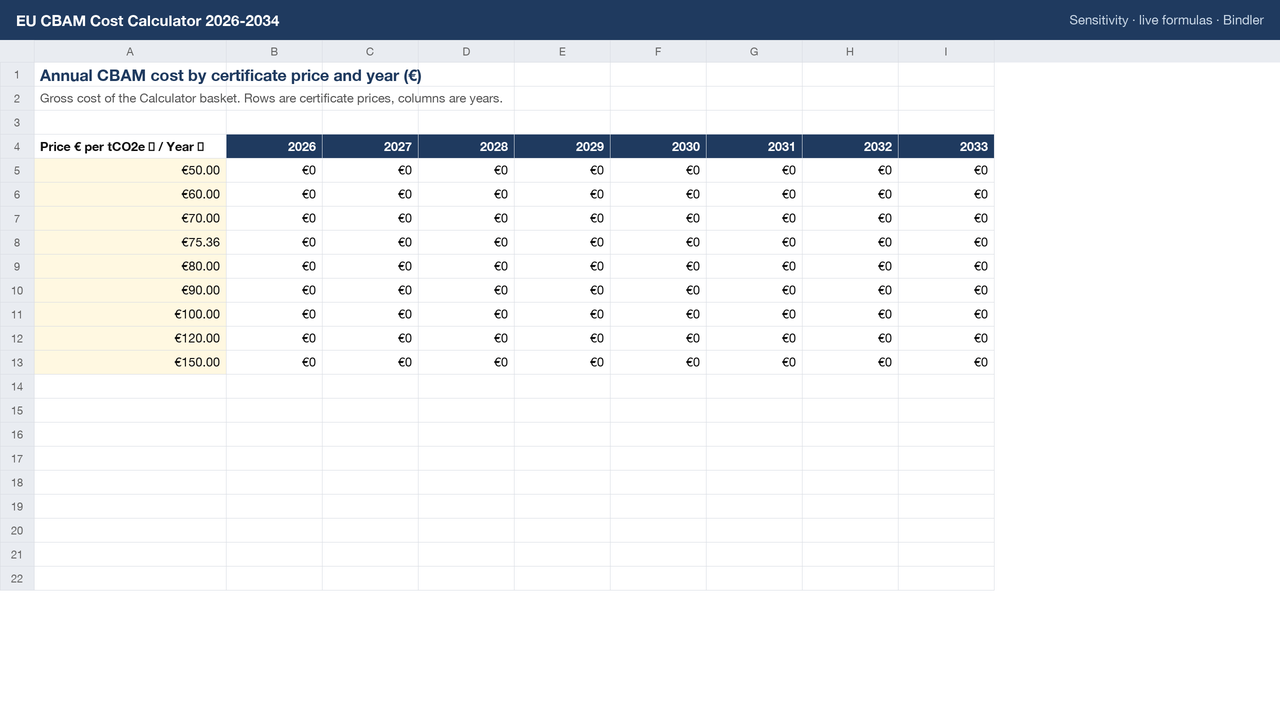
The workbook was recalculated with a formula engine before listing and its worked example checked by hand: 1,000 tonnes of steel at 2.0 tCO2e per tonne is 2,000 tCO2e embedded, 50 chargeable tCO2e in 2026 at the 2.5% factor, 50 certificates at the Q1 2026 price of EUR 75.36, EUR 3,768. The same shipment in 2034 needs 2,000 certificates. The cost method behind it is set out in the CBAM cost guide and the dates in the CBAM definitive period timeline.
What it does not do
It does not file anything: the declaration is submitted in the CBAM Registry by the authorised declarant. It does not calculate embedded emissions from production data; those come from the producer's verified monitoring or the Commission's default values. It does not forecast EU ETS prices.
Sources
- Regulation (EU) 2023/956 establishing a carbon border adjustment mechanism: Article 6 (the CBAM declaration), Article 9 (carbon price paid in a third country), Article 35 (transitional-period reporting), Annex I and II: eur-lex.europa.eu/eli/reg/2023/956/oj.
- Regulation (EU) 2025/2083 amending Regulation (EU) 2023/956 (CBAM simplification), OJ 17 October 2025, in force 20 October 2025: the 50 tonne threshold, the 30 September declaration and surrender date, certificate sales from 1 February 2027, the 50% quarterly holding, the 31 March 2026 provisional import rule. Read as summarised by Mayer Brown (mayerbrown.com, October 2025) and EY (ey.com tax alert).
- Directive (EU) 2023/959, Article 10a(1a): the free allocation phase-out schedule: eur-lex.europa.eu/eli/dir/2023/959/oj.
- European Commission, CBAM certificate price page: taxation-customs.ec.europa.eu/carbon-border-adjustment-mechanism/price-cbam-certificates_en.
Search terms this page answers: cbam quarterly report template, cbam quarterly report 2026, cbam annual declaration 2027, cbam declaration contents, cbam definitive period reporting, cbam report excel template.