EU Taxonomy Article 8 KPI template: the turnover, CapEx and OpEx KPIs after Delegated Regulation (EU) 2026/73, and an Excel workbook that computes them
If you are looking for an EU Taxonomy Article 8 KPI template in 2026, there are two things to know before you download anything. First, the template changed: the 21-column Annex II table that every company used for FY2022 to FY2024 was replaced on 8 January 2026 by two shorter templates. Second, the arithmetic behind the template did not change: three denominators, one numerator each, and an activity-by-activity screen against Article 3. This page sets out what the KPIs are, what the new templates ask for, what the 10% non-material rule lets you leave out, and the Excel workbook Bindler built to do the screen and the arithmetic. It is a working aid for preparers, not legal advice and not assurance.
The three KPIs, and where they come from
Article 8(2) of Regulation (EU) 2020/852 asks every non-financial undertaking in the CSRD's scope to disclose the proportion of its turnover, capital expenditure and operating expenditure that is associated with environmentally sustainable (Taxonomy-aligned) economic activities. Delegated Regulation (EU) 2021/2178 defines each ratio in Annex I:
- Turnover KPI (Section 1.1.1): numerator is net turnover from Taxonomy-aligned activities; denominator is net turnover as defined in IAS 1.82(a) or the national GAAP equivalent.
- CapEx KPI (Section 1.1.2): numerator is additions to tangible and intangible assets that relate to aligned activities, are part of a CapEx plan to make an activity aligned within five years, or are individual measures listed in Annex I; denominator is all such additions in the year, before depreciation and including business combinations.
- OpEx KPI (Section 1.1.3): numerator and denominator cover direct non-capitalised costs for research and development, building renovation, short-term leases, maintenance and repair, and day-to-day servicing of property, plant and equipment.
An activity counts in a numerator only if it passes all four Article 3 conditions: substantial contribution to one of the six objectives under the technical screening criteria, no significant harm to the other five, minimum safeguards (Article 18), and the criteria of the delegated act for that objective. Eligible-but-not-aligned activities are reported separately, and everything not in a delegated act is non-eligible.
What Delegated Regulation (EU) 2026/73 changed
Commission Delegated Regulation (EU) 2026/73 of 4 July 2025 was published in the Official Journal on 8 January 2026, entered into force on 28 January 2026, and applies from 1 January 2026. Under its Article 4, undertakings may still apply Delegated Regulations 2021/2178, 2021/2139 and 2023/2486 as they stood on 31 December 2025 for a financial year that starts between 1 January and 31 December 2025. So an FY2025 report can use either layout; an FY2026 report uses the new one.
For the non-financial KPIs the changes are:
- The 10% non-material rule (new Article 2(1a) to (1d) of 2021/2178). For each KPI, an undertaking may omit assessing eligibility and alignment for activities whose cumulative turnover (or CapEx, or OpEx) is below 10% of that KPI's denominator. The omitted amount is reported separately as non-material. The rule is all or nothing per activity: an activity treated as material is assessed for its whole amount, and no part of a material activity can be put in the non-material column.
- OpEx opt-out (Article 2(1c)). Where operating expenditure is not material for the business model, the undertaking may skip the OpEx assessment altogether, provided it discloses the total OpEx denominator and explains why OpEx is not material. Where OpEx is material, the 10% rule applies to it like the other two.
- Annex II replaced. Template 1 is a summary with one row per KPI and 16 columns: total (the denominator), proportion eligible, aligned amount and proportion, the aligned proportion by each of the six objectives, enabling, transitional, non-material, and the prior year's aligned amount and proportion. Template 2 is the activity breakdown, 14 columns, repeated once per KPI, with a code per activity (CCM 4.1 for solar PV, for example), the eligible and aligned proportions, the objective columns, E and T markers, and the aligned share of the eligible amount. Template 2 may be omitted for a KPI whose eligible proportion is zero in Template 1.
- Annex XII deleted. The separate fossil gas and nuclear templates are gone; those activities are disclosed on the same rows as everything else.
- DNSH pollution criteria simplified (Annexes XII to XVI of 2026/73, amending the Climate and Environmental Delegated Acts). Appendix C, the generic chemicals test, is replaced: the recitals explain that screening every product for substances that merely meet the Article 57 REACH hazard criteria, with no supply-chain duty to report them in articles, was removed; the remaining test on that point covers substances identified under Article 59(1) of REACH for at least 18 months, above 0.1% by weight, unless the operator documents that no suitable alternative exists and controlled use. The substantial contribution criteria for climate change mitigation and adaptation are not amended (recital 22).
The workbook, and how it maps onto Template 1
The EU Taxonomy Alignment Screen and Article 8 KPI Workbook takes the activity register and returns the three KPIs. Eight sheets, live formulas, no macros, no locked cells:
1. Summary: the three denominators (inputs), then eligible amount, aligned amount, eligible-not-aligned, non-eligible, the aligned proportion, the eligible proportion, the enabling and transitional shares, a prior-year input, and four checks (eligible not above the denominator, register rows with no substantial-contribution answer, quantitative tests waiting on a metric, aligned row count).
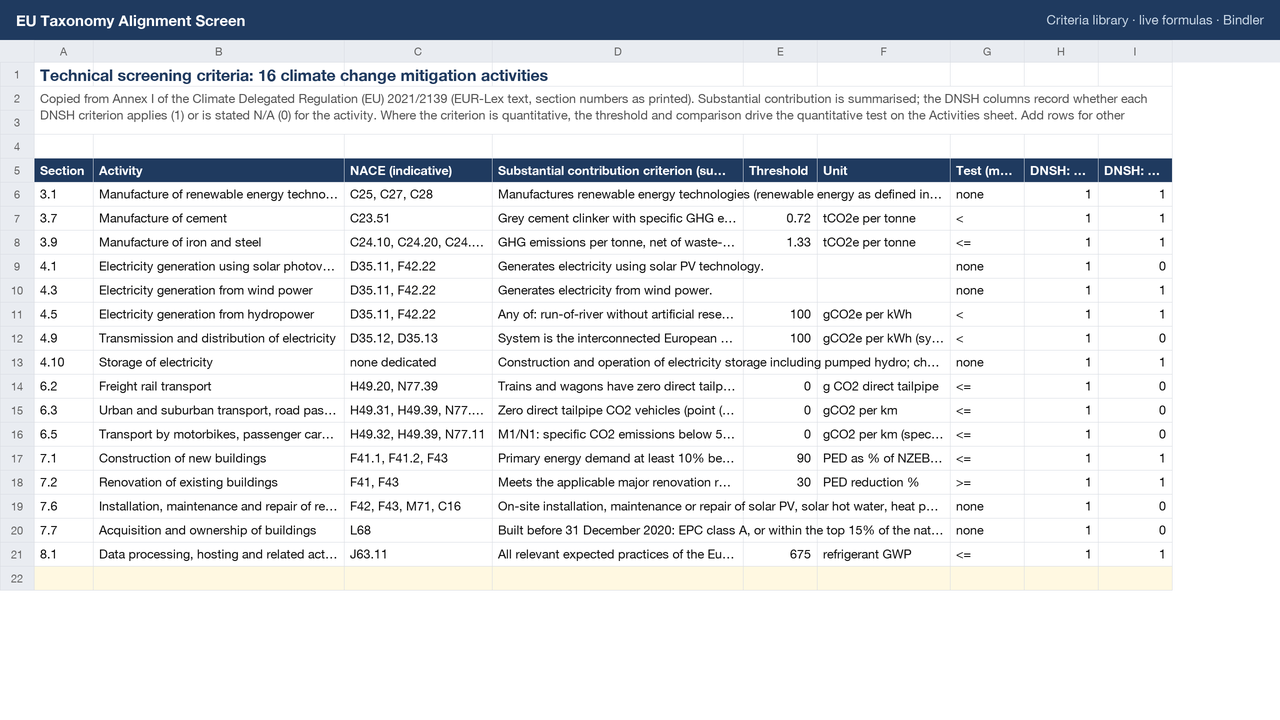
2. Criteria library: 16 climate change mitigation activities from Annex I of Delegated Regulation (EU) 2021/2139 (sections 3.1, 3.7, 3.9, 4.1, 4.3, 4.5, 4.9, 4.10, 6.2, 6.3, 6.5, 7.1, 7.2, 7.6, 7.7, 8.1) with the substantial contribution criterion summarised, the threshold and unit where the test is quantitative, which of the five DNSH criteria apply to that activity, and the enabling or transitional flag. Fourteen blank rows take activities you add from the delegated acts.
3. Activities: one row per activity or per activity per segment. Pick the section code and the name, eligibility, DNSH applicability and category fill in. Enter turnover, CapEx and OpEx, the metric value where the criterion is quantitative (the sheet says Pass or Fail against the library threshold), then answer substantial contribution, the applicable DNSH questions and minimum safeguards. Taxonomy-aligned computes from those answers; the aligned amounts flow to the Summary.
4. Turnover KPI, CapEx KPI, OpEx KPI: the activity-level table in the 21-column layout of Annex II as it stood before 2026/73, with rows A.1 (aligned), A.2 (eligible not aligned) and B (non-eligible), DNSH columns showing N/A only where the library says the objective does not apply, and E and T markers.
5. Guide and Sources: how to use it, the CapEx plan rule, the adaptation exclusion, and the article behind every figure.
The KPI sheets carry the pre-2026 layout, so here is how the workbook's figures fill the new Template 1 for the turnover row (CapEx and OpEx are the same mapping on their own rows):
| Template 1 column | Workbook cell or figure |
|---|---|
| (2) Total | Summary, denominator input |
| (3) Proportion of Taxonomy-eligible activities | Summary, eligible proportion (A / denominator) |
| (4) Taxonomy-aligned activities, currency | Summary, Taxonomy-aligned amount (A.1) |
| (5) Proportion of Taxonomy-aligned activities | Summary, KPI aligned proportion (A.1 / denominator) |
| (6) Climate change mitigation | equal to column (5) while the library holds mitigation activities only; add other objectives' activities to the library to split it |
| (7) to (11) other objectives | blank unless you add activities under those objectives |
| (12) Proportion of enabling activities | Summary, of which enabling (E) |
| (13) Proportion of transitional activities | Summary, of which transitional (T) |
| (14) Not assessed, considered non-material | the amounts you chose to leave out of the register under the 10% rule, divided by the denominator; keep the list on the Evidence column of the Activities sheet |
| (15) and (16) previous year | Summary, prior-year aligned proportion input, and the prior year's aligned amount |
Template 2 for each KPI is the Activities sheet read row by row: the code is "CCM " plus the section code, the eligible and aligned proportions are the row's amount over the denominator, and column (14) is the aligned share of the eligible amount for that row. A version of the workbook with the KPI sheets rebuilt in the Template 1 and Template 2 layout, and a non-material line on the Summary, is the next update to this product; buyers get updates on Gumroad at no charge.
A worked case from the workbook's own test
The workbook ships verified against a six-activity register with a turnover denominator of 1,000m: aligned turnover 580m, so the KPI is 58%; eligible 75%; enabling 8%; transitional 20%; CapEx KPI 67.5%; OpEx KPI 56%. Two quantitative tests are in the case: a hydropower plant at 120 gCO2e/kWh fails the 100 gCO2e/kWh life-cycle threshold of section 4.5, and a cement plant at 0.70 tCO2e per tonne of clinker passes the 0.722 threshold of section 3.7. The DNSH and safeguards failures in the case each drop the row from A.1 to A.2 and the totals move accordingly. All of those figures were checked by hand before listing.


What it does not do
It screens climate change mitigation activities; the four environmental objectives and adaptation need rows you add from Delegated Regulation (EU) 2023/2486 and Annex II of 2021/2139. It does not decide materiality for you: the 10% rule is a choice you document, and the workbook only holds the amounts you leave out. It is not the financial-undertaking KPIs (green asset ratio, and the rest), which sit in Annexes III to XI and were simplified separately by the same regulation.
If the Taxonomy KPIs sit inside a CSRD sustainability statement, the double materiality template is the workbook that comes before this one, and the CSRD deadlines page says whether and when you report at all.
Sources
- Commission Delegated Regulation (EU) 2026/73 of 4 July 2025, OJ L, 8 January 2026, in force 28 January 2026, applying from 1 January 2026 (Article 4; Article 1 points (1), (10) and (20); Annex II Templates 1 and 2 and their explanatory notes): eur-lex.europa.eu/eli/reg_del/2026/73/oj.
- Regulation (EU) 2020/852 (Taxonomy Regulation), Articles 3, 8, 9, 10, 16, 17 and 18: eur-lex.europa.eu/eli/reg/2020/852/oj.
- Commission Delegated Regulation (EU) 2021/2178 (Disclosures Delegated Act), Annex I Sections 1.1.1 to 1.1.3, Annex II as it stood until 31 December 2025: eur-lex.europa.eu/eli/reg_del/2021/2178/oj.
- Commission Delegated Regulation (EU) 2021/2139 (Climate Delegated Act), Annex I sections listed above: eur-lex.europa.eu/eli/reg_del/2021/2139/oj.
- The workbook's Sources sheet, which names the article behind each figure.
Last checked against the sources on 20 September 2026.
Search terms this page answers: eu taxonomy article 8 kpi template, taxonomy kpi template excel, taxonomy turnover capex opex kpi, taxonomy annex ii template 2026, taxonomy 10 percent materiality threshold, delegated regulation 2026/73, taxonomy alignment screen excel.